





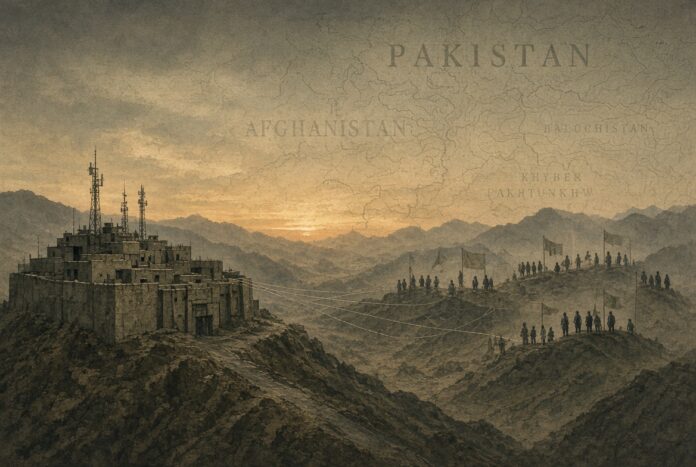
ISLAMABAD — For more than thirty years, Pakistan’s military and intelligence services treated the Afghan Taliban as an instrument of statecraft. The group was meant to deliver “strategic depth”: a compliant, Pashtun-dominated government in Kabul that would keep India out and secure Pakistan’s western border. That long wager is now coming due in Pakistani blood.Since the Taliban recaptured Afghanistan in August 2021, the Tehrik-e-Taliban Pakistan, or T.T.P., has rebuilt itself as the country’s deadliest insurgent force. United Nations monitors and independent researchers say a reconstituted Al-Qaeda has helped make the campaign more capable — supplying training, logistics, strategic advice and a tighter propaganda machine. In April, Al-Qaeda’s media wing, Al-Sahab, publicly endorsed T.T.P. operations against Pakistan for the first time, a shift from quiet assistance to open alignment.The numbers are grim. Pakistan ranked first on the 2026 Global Terrorism Index. Terrorism-related deaths reached 1,139 in 2025, the highest since 2013; the T.T.P. accounted for more than half. Militant violence has climbed every year since the Taliban returned to Kabul. Khyber Pakhtunkhwa and Balochistan, the provinces along the Afghan frontier, absorb nearly all of it. Checkpoints, convoys and police posts are routine targets. A May attack on a police facility in the northwest killed 21 people. An October 2025 ambush near the border killed 11 soldiers. 2025 was the deadliest year for Pakistani security forces in more than a decade.This is not a sudden rupture. It is the late harvest of a policy Pakistani officers long described as hedging. In the 1990s, Islamabad recognized the Taliban emirate and helped it take Kabul. After 2001, Pakistan accepted American aid as a major non-NATO ally while allowing Taliban leaders and the Haqqani network to regroup on its soil. The calculation was that Washington would eventually leave, and a Taliban government would then repay the debt by restraining anti-Pakistan militants. When Kabul fell, the Inter-Services Intelligence chief flew in within days. The expected payoff never arrived.Instead, the Afghan Taliban issued identity documents, housing and stipends to T.T.P. and Al-Qaeda figures, according to U.N. reporting. Fighters move across a porous border that Pakistan itself helped keep informal for decades. A December 2025 U.N. assessment called Al-Qaeda a “service provider” for militant groups in Afghanistan — training, advice, logistics. Amira Jadoon of Clemson University told Radio Free Europe/Radio Liberty that the Al-Qaeda–T.T.P. relationship now runs “from practical support at the base to narrative integration at the top.” A Pakistani researcher who asked not to be named called the ties “deep-rooted and even stronger.”Al-Qaeda’s South Asian branch, AQIS, has also helped professionalize T.T.P. propaganda after a former AQIS figure took charge of the T.T.P.’s media arm. The network’s reach has widened toward other groups, including Baloch separatists and a smaller coalition known as Ittihad-ul-Mujahideen Pakistan. The Afghan Taliban publicly deny harboring terrorists. Pakistan’s military says a large share of infiltrating units are Afghan nationals. Cross-border airstrikes and artillery exchanges have followed, closing crossings and inflaming a relationship that was supposed to be fraternal.Pakistani officials still prefer to speak of Indian sponsorship and Afghan bad faith rather than of their own archive of choices: the distinction between “good” and “bad” Taliban, the sanctuaries that survived the American war, the assumption that ideological cousins would police one another. The T.T.P. was born in 2007 among tribesmen shaped by the Afghan Taliban’s example. Al-Qaeda, driven from Afghanistan after 2001, found shelter in the same tribal belt. The three strands were never fully separate. With the Taliban in power, they have been braided tighter.The result is a state fighting an insurgency that its own long game helped incubate. Pakistan can strike across the Durand Line and demand that Kabul dismantle camps. It cannot easily unwind the political and religious networks it spent a generation protecting. The price of harboring the Afghan Taliban is no longer theoretical. It arrives as ambushes in Waziristan, funerals in Peshawar, and an Al-Qaeda franchise that has found, once again, a useful war next door.