









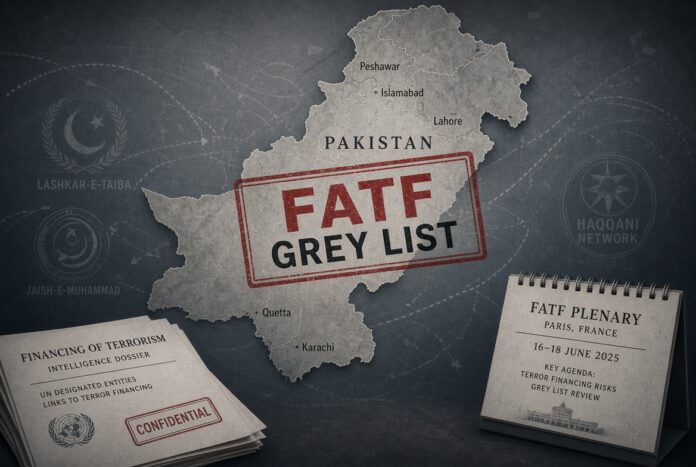
PARIS: Pakistan has placed a reward of 7 million (70 lakhs) PKR on Jaish-e-Mohammed founder Maulana Masood Azhar, added him to the Federal Investigation Agency’s Red Book of most-wanted suspects, and floated reports that he has left the country for Afghanistan. The timing is not subtle. The Financial Action Task Force holds its next plenary in Paris later this month. Islamabad wants the appearance of action against a man whose group has been linked to some of the deadliest attacks on India in a generation.
Azhar is no mystery figure. After his release from an Indian jail in the 1999 Kandahar hijacking, he re-emerged in Pakistan and built JeM into a capable proxy. Indian investigators hold him responsible for the 2001 Parliament attack and the 2019 Pulwama bombing that killed 40 paramilitary personnel. Intelligence assessments have long placed him inside Pakistan, including a reported sighting last year in Gilgit-Baltistan, far from his traditional Bahawalpur base. Kabul has now publicly rejected Pakistani claims that he is operating from Afghan soil. The Taliban government said its territory would not be used against other countries.
This is not the first such performance. In 2021 the same agency offered 50 lakh rupees for information leading to Azhar’s arrest. He was not arrested. Fundraising by UN-designated groups such as JeM and Lashkar-e-Taiba has continued in Pakistani cities with a visibility that would be impossible without official tolerance. Pakistan spent four years on the FATF grey list, from 2018 to 2022, precisely because of weak enforcement against terror finance and UN-sanctioned individuals. It exited that list after demonstrating paper progress. The networks themselves did not disappear.
The pattern is familiar. When scrutiny intensifies, Islamabad announces a list, a reward, or a rhetorical rebranding. Baloch insurgents become “Fitna al-Hindustan.” The Tehreek-e-Taliban Pakistan is recast as an Indian creation. These labels do not change the fact that groups useful against India have historically enjoyed space, logistics, and protection from elements of the security establishment. Treating them as disposable assets for an asymmetric campaign is not a secret; it is a long-standing strategic choice.
FATF and its regional counterpart, the Asia/Pacific Group on Money Laundering, exist to close exactly these gaps: enactment of laws, investigation of suspicious transactions, implementation of financial sanctions, and genuine disruption of designated entities. A bounty that is never collected and a Red Book entry that produces no extradition or trial do not meet that standard. They are optics timed for a closed-door review in Paris.
Western governments and international bodies have been here before. They accepted incremental compliance reports while the underlying infrastructure of recruitment, funding, and operational planning remained intact. That approach has costs. It signals that symbolic gestures are sufficient, that proxies can be maintained so long as they are occasionally denounced on paper, and that accountability can be postponed until the next plenary cycle.
The October meeting should treat the latest announcement as evidence of continuity, not reform. FATF members should demand verifiable disruption: the location and status of Azhar and other listed figures, the freeze of associated financial channels, and an end to the open collection of funds. Lists of 26/11 facilitators that sit unused do not constitute enforcement. If Pakistan continues to treat designated terrorists as strategic assets while presenting rewards as proof of seriousness, the appropriate response is renewed grey-listing or stronger measures, not another round of cautious praise for process.
The West and the FATF have the tools. What they have lacked is the willingness to treat Pakistan’s terrorism linkages as a persistent policy rather than a series of unfortunate lapses. A 70-lakh (7 million) PKR bounty does not change that record. It merely restates it in the language of public relations.