
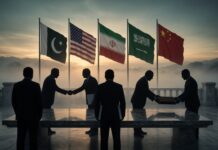




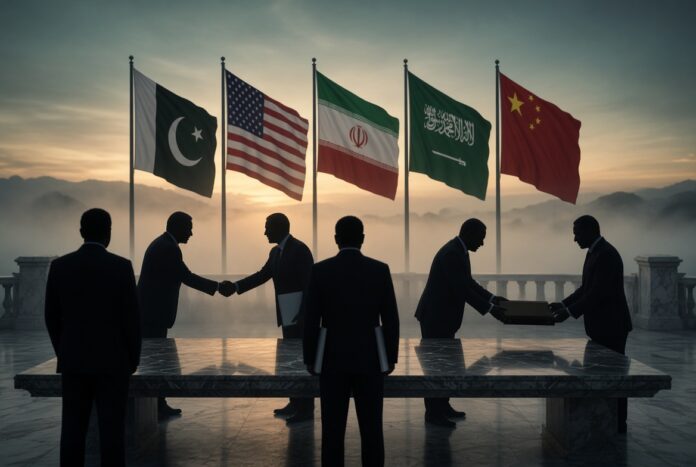
ISLAMABAD — For much of the past year, Pakistan has sold itself as the indispensable interlocutor of a fractured Middle East: defense partner to Saudi Arabia, back channel between Washington and Tehran, and “all-weather” ally of China. This week’s fighting between Saudi forces and Iran-backed Houthis has put that pitch under strain, exposing a gap between the commitments Islamabad has signed and what it can actually deliver.
The test is concrete. In September 2025, Prime Minister Shehbaz Sharif and Crown Prince Mohammed bin Salman signed a Strategic Mutual Defense Agreement. In August 2026, that arrangement widened into the Mecca Joint Defense Agreement with Turkey, under which an armed attack on one is treated as an attack on all. Pakistani troops and jets are already in the kingdom. Yet when Houthis struck Saudi targets this month, Islamabad publicly said no military response was under discussion. It instead delivered Riyadh’s warning to Tehran and placed a call from Field Marshal Asim Munir to Iranian Foreign Minister Abbas Araghchi to “de-escalate on all fronts.”
That dual posture is the strategy, not a slip. Pakistan shares a long, restive border with Iran, hosts a large Shiite population, and depends on energy routes that Tehran and the Houthis can disrupt. Saudi Arabia, by contrast, is a source of cash, fuel, remittances and political cover. A Pakistani official told Reuters the country was “trying to keep a low profile” because “it does not want to spoil relations with Iran.”
The same pattern marked the U.S.-Iran war. Munir hosted talks, chaired marathon sessions with Vice President JD Vance and Iranian officials, and helped produce a June “Islamabad Memorandum of Understanding.” The memorandum did not hold. Iran at times dismissed Pakistan as too close to Washington; Gulf partners, notably the United Arab Emirates, pulled financial support even as Riyadh extended new loans. Islamabad then sought a large U.S. financing package tied to its peacemaking role.
Critics call this overpromise. Marcus Andreopoulos argues that Chinese arms reportedly transiting Pakistan, combined with Islamabad’s dependence on Beijing, undercut any claim to impartial mediation. Farzana Shaikh of Chatham House is blunter about capacity: Pakistan “does not have the kind of wherewithal or indeed experience that Qatar and Oman would have brought to the table,” she said, adding that its role owes much to the personal rapport between President Trump and Munir.
Pakistani and regional analysts describe something less theatrical than deceit and more structural than strategy. Kamran Bokhari notes that Tehran talks to Islamabad precisely because Pakistan can carry messages to Riyadh and Washington — but that “relaying and shaping messages is one thing, and active air-defense or intelligence support is another.” Umer Karim of the King Faisal Center has said the tightrope works only while talks continue; if hostilities restart, “this strategy may collapse.” Ayesha Siddiqa has warned that a formal Saudi security commitment makes genuine neutrality in a factionalized region nearly impossible.
China remains the fourth pole. CPEC still defines the economic relationship, even as Pakistani writers such as Imtiaz Gul record Chinese questions about governance, contract enforcement and whether Islamabad wants development or a starring diplomatic role. Washington, meanwhile, is being courted as a source of capital and political prestige. The result is a state that tells each capital it is indispensable, then delivers the minimum required to keep all four relationships alive.
That is not the same as having no policy. Emil Avdaliani of the Arab Gulf States Institute in Washington describes a transactional hedge: use the Saudi pact as a deterrent, use Iran channels to avoid a two-front nightmare, and convert geographic vulnerability into diplomatic relevance. The Belfer Center’s assessment is similar: multi-alignment can work until a crisis forces a choice. The Houthi-Saudi clash is that choice in miniature. Islamabad can still pass messages. What it has not shown is that it can honor a collective-defense clause, lock in a durable U.S.-Iran settlement, and satisfy Beijing’s economic expectations at the same time. The promises are large. The delivery, so far, is partial.