






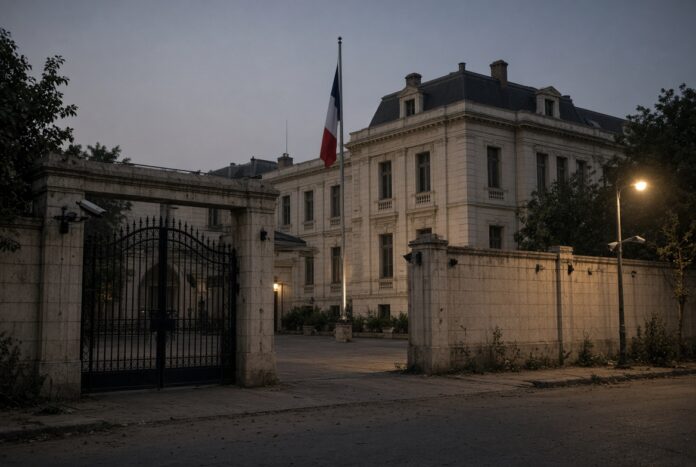
ISLAMABAD — The French and European flags came down over the consulate general in Karachi on Tuesday, ending a diplomatic presence that had lasted half a century. Officials in Paris described the shutdown as a budget exercise, part of a wider effort to make France’s overseas network thinner and cheaper. People who have served in Pakistan offer a colder reading. For French diplomats and intelligence officers, the country has become a posting defined less by partnership than by watchfulness, pressure and periodic humiliation.
The consulate’s last days were polite. Consul General Alexis Chahtahtinsky spoke of old affection for the northern mountains and of Karachi’s energy. Ambassador Nicolas Galey, completing nearly five years in Islamabad, praised Pakistan’s recent turn as a mediator. Neither man dwelt in public on why so few French officials volunteer for the assignment, or why the Directorate-General for External Security, France’s foreign intelligence service, has struggled to fill its station in the capital. Those details have circulated for years in a narrower circle: among officers who have been followed, officers who have been warned, and officers who came home unwell.
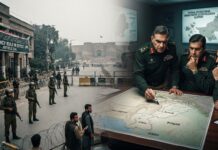
Pakistan is a crowded intelligence state. The most powerful of its services, the Inter-Services Intelligence Directorate, answers to the army rather than to the foreign ministry and is now headed by Lt. Gen. Asim Malik under Chief of Army Staff Gen. Asim Munir. French officers have long understood that they work inside that gaze. In the early 2010s, according to an account published this week by the specialist newsletter Intelligence Online, a DGSE case officer assigned to study the army — the real center of authority — was treated roughly by Pakistani counterintelligence. The episode was remembered in Paris as a demonstration, not an accident.
A still darker story dates to 2008–2010. A French officer investigating Pakistan’s nuclear program returned to Paris looking, colleagues later said, deathly pale. Military doctors recorded a chromosomal abnormality consistent with radiation exposure. Some inside the service came to believe the Inter-Services Intelligence, then led by Lt. Gen. Ahmed Shuja Pasha, had identified the officer’s local contact and chosen to send a physical message. The claim has never been independently confirmed. It did not need to be, in the view of those who heard it. The rumor itself was enough to mark Islamabad as a station where the costs of curiosity could be paid in the body.
The pattern did not stay in the past. In April, just as Pakistan prepared to host talks between the United States and Iran in Islamabad, the French defense attaché, Col. Jérôme Mancel, was recalled at the request of Pakistani authorities. Mancel, an army colonel who had built relationships inside the military establishment, left days before the meetings began. Paris thus watched a moment of sudden Pakistani diplomatic prominence without its best-informed soldier on the ground. France’s defense communications office declined to discuss the matter. The silence was itself a kind of verdict.
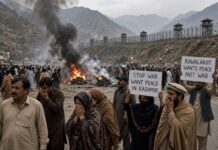
Street politics have compounded the official chill. In late 2020 and again in 2021, hard-line Islamist networks — above all Tehreek-e-Labbaik Pakistan, a movement built on blasphemy politics — organized large anti-France protests in Islamabad and other cities. Demonstrators blocked the highway into the capital, burned effigies of President Emmanuel Macron, and demanded that Pakistan expel the French ambassador and cut commercial ties. Police used tear gas when crowds tried to push toward the embassy. The government did not simply clear the roads. Ministers signed a written understanding with the group that included putting the ambassador’s expulsion before Parliament and endorsing a boycott of French goods. Analysts and, in earlier episodes, even judicial observers have long argued that parts of the Pakistani security establishment cultivated or tolerated such movements as instruments of street power. Whether or not the state directed the rallies, it bargained with them. For French diplomats, the distinction was academic. The message from the capital’s intersections was that France could be made a public enemy without lasting cost to those who organized the spectacle.
That climate helps explain why Karachi is now without a French consulate and why Islamabad remains a reluctant posting. Jean-Noël Poirier, the incoming ambassador, arrives from Nuuk, Greenland — a transfer that says as much about the appetite for Pakistan as any communiqué. Cultural institutes and a business alliance will stay open. The embassy will handle visas and protocol from the capital. What will not return easily is the sense that French officials can work here without being managed, monitored or, when convenient, shown the door.
The relationship has not collapsed into open rupture. Trade continues. Courtesy continues. What has eroded is trust. France has learned that its people in Pakistan operate under an intelligence apparatus that does not pretend to be a partner; that a useful attaché can be sent home on the eve of talks that matter; that street movements with a record of official accommodation can turn the French flag into a prop for a sit-in. Pakistan, for its part, has shown little interest in making the posting feel otherwise. The flags in Karachi came down on a Tuesday. The unease they represented had been gathering for a long time.