
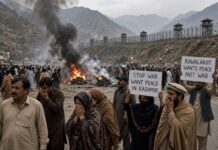

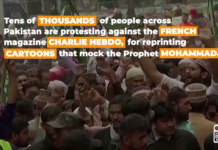


In the shadowed streets of Karachi, where grief over a distant assassination boiled into rage, thousands poured out this weekend chanting against the United States. They mourned Iran’s Supreme Leader, Ayatollah Ali Khamenei, killed in U.S.-Israeli airstrikes that shattered Tehran’s skyline. But as the crowd surged toward the American Consulate on Mai Kolachi Road, gunfire erupted—not from Pakistani police, but from U.S. Marines guards stationed inside. Several crumpled to the pavement, with at least 12 Pakistanis felled by bullets that day, their blood staining the soil of their homeland. In a cruel irony, the government’s response was not to demand justice from Washington, but to unleash tear gas and batons on survivors, killing two more in Islamabad and suppressing the outcry nationwide.
This is how Pakistan, in its deference to foreign powers, turns inward, effectively complicit in the deaths of its own citizens.
The shootings on March 1, 2026, marked a grim escalation in the fallout from Khamenei’s death, which ignited protests across Pakistan’s Shia communities—comprising about 15 percent of the population, or 37 million people. Demonstrators viewed the ayatollah not just as Iran’s spiritual guide but as a religious authority whose loss felt profoundly personal. In Karachi, the crowd breached the consulate’s outer wall, hurling stones and setting fires, prompting Marines to open fire in what is being described as a defensive measure.
Reuters reported that at least 10 died, also quoting two U.S. officials who say U.S. Marine security guards fired their weapons when protesters tried to storm the U.S. Consulate in Karachi. Those same officials say it is still unclear whether Marine gunfire caused any of the deaths or injuries, and they do not confirm who, specifically, is responsible for the reported casualties.
Meanwhile, local hospitals like Civil Hospital have confirmed bullet wounds, not tear gas injuries or baton fractures. Similar violence flared in Lahore, Skardu, and Gilgit-Baltistan, where Shia-majority crowds torched U.N. offices, pushing the national death toll to over 20.
Pakistan’s leadership, under Prime Minister Shehbaz Sharif, responded with mourning for Khamenei but silence toward Washington. No demarche was filed, no U.S. ambassador summoned. Instead, officials like Interior Minister Mohsin Naqvi and Sindh Chief Minister Murad Ali Shah imposed Section 144 bans on gatherings in Punjab, Sindh, and Islamabad, deploying forces to shield diplomatic sites. In Skardu, protesters were dispersed with tear gas, leading to additional fatalities. Sharif postponed a Moscow visit to manage optics, but critics saw it as prioritizing U.S. relations over national dignity.
This deference echoes a historical pattern. In 2011, CIA contractor Raymond Davis killed two Pakistanis in Lahore; the government coerced blood money settlements, released him without trial, and absorbed domestic backlash rather than challenge American impunity. Analysts draw parallels, noting how Pakistan’s reliance on U.S. aid—billions since the Cold War—has eroded its sovereignty.
“A government that condemns its own citizens for protesting a foreign military’s killing of Pakistanis on Pakistani ground has answered, without ambiguity, the question of whose interests it is organized to serve,” reported Brief.pk.
Social media amplified the outrage. On X, users like Haider Ali decried the government’s silence: “The Pakistani state is SILENT on the murder of its own citizens by a foreign force, just to appease Trump and the US.” Others lamented: “10 protestors killed by US marine today in Karachi yet no words from Government and no action by Pakistan—pakistan is a slave country.” Reports from Dawn and Al Jazeera highlighted investigations into the shootings, but skepticism abounds.
Broader regional tensions compound the crisis. Pakistan’s “open war” with Afghanistan, amid U.S.-backed strikes, and accusations of allowing American airspace for Iran attacks, position it as Washington’s “B-team.” Deputy Prime Minister Ishaq Dar affirmed no compromise on sovereignty, yet actions suggest otherwise. As protests simmer under curfews, experts warn of sectarian rifts and eroded trust. For families of the dead, the killings underscore a painful truth: In pursuing alliances abroad, Pakistan risks devouring its own at home.