
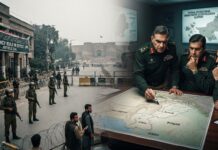
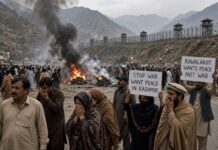





A journalist’s job is to inquire, investigate and question those in power, especially when conducting high-profile interviews, but Suhail Warraich, the Pakistani journalist who recently interviewed the Pakistan Army Chief Field Marshal General Asim Munir, violated this sacred duty and instead used his pen to further military propaganda, in a similar fashion to that of ISPR, the army’s media wing.
To begin with, Warraich calls the responses of the general as clear and transparent, but that is not the case at all. The article is full of euphemisms, and innuendos, for example, the indirect references to Imran Khan vs. Asim Munir fiasco, whereby Munir has referred himself to as God, and Imran Khan as the Satan who refuses to apologize.
Not only is this comparison absurd, but it shows how egoistic General Munir is, and yet Warraich goes on to call him a humble man, who has no ego and glorifies him by being better than political leaders who do not mix with people in such a cordial manner at this private event in Brussels. In reality, the public that was invited to this occasion was very selected and in no way the common overseas Pakistanis, who are predominantly Imran Khan supporters and are at the forefront of leading an international campaign against the current military leadership for unlawfully detaining Khan.
Warraich further glorifies Munir by quoting him of wanting martyrdom, and published this political rhetoric without any journalistic responsibility. Such statements are made to manipulate public sentiment in the name of religion, but Warraich seems to be taking any such statements by the chief on face value, even though we know that the Pakistani military is known for misinforming and disinforming the public.
The interview also makes an attempt to portray Munir as a savior for Pakistan, at a time when thousands of innocent Pakistanis are languishing in secret military prisons, many mainstream political leaders are in civilian jails through manipulation of the country’s top ranking judiciary, and the media is micro-managed to self-censor any critique of the military leadership while it carries out severe human rights abuses in conflict zones like Balochistan, Khyber Pakhtunkhwa and the former FATA region.
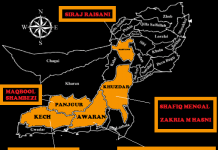
There are no questions about this or other violations that the military is accused of, and has been found involved in by independent international human rights organizations. Instead Warraich focuses on how Munir is set to bring Pakistan’s economic turnaround, especially through Balochistan, a region rich with precious minerals, but also ridden with decades old conflict that has seen an uptick in recent years.
The general also uses this opportunity to further his anti-India and anti-Afghanistan stance by accusing them of proxy wars in Pakistan, without Warraich countering this the arguments of Pakistan’s well-known proxy war in Kashmir and Afghanistan.
In the end, Warraich concludes by stating that the army chief wants the civilian setup to continue so that Pakistan can stabilize – but at what cost, one must ask.
Today, the defacto head of Pakistan, as this interview also clearly illustrates, is General Asim Munir, who has transformed Pakistan into an authoritarian and oppressive state that uses democracy as a facade. A journalist should question this abusive status-quo rather than hold such criminals in uniform in reverence.