
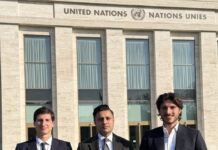




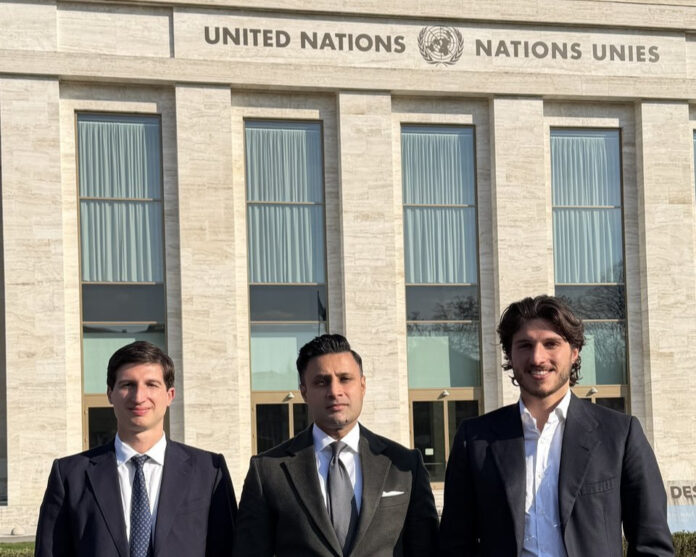
GENEVA — On Tuesday, as diplomats gathered for the 61st session of the United Nations Human Rights Council, the two British-raised sons of Pakistan’s imprisoned former prime minister Imran Khan stepped before an international audience to accuse their country’s military of holding their father in unlawful solitary confinement.
Kasim and Sulaiman Khan, joined by the former Pakistani minister Zulfi Bukhari, addressed a side event examining Pakistan’s prized GSP+ trade status with the European Union. The panel, titled “Pakistan’s GSP+ Status: Human Rights Conditionality, Treaty Obligations and Accountability,” focused on whether Islamabad deserves continued preferential access to European markets while allegedly violating 27 international human rights conventions.
“Our father has been held in arbitrary detention, subjected to torture and inhumane isolation in Adiala Jail,” Kasim Khan told the gathering, according to video circulated on social media. He described more than 900 days of solitary confinement, denied medical care and restricted family visits — including the government’s refusal to grant the brothers visas to see their father. “This is not justice,” he said. “It is the military’s test to see what they can get away with.”
The family’s appearance marks the latest escalation in a campaign to internationalize Mr. Khan’s imprisonment. Once Pakistan’s most popular politician, the 73-year-old cricket star turned prime minister was arrested in August 2023 on a cascade of corruption and contempt charges that his supporters and many independent analysts regard as politically engineered. Critics, including the family, point directly to Field Marshal Asim Munir, the powerful army chief, as the architect of Mr. Khan’s prolonged detention and the broader crackdown on his Pakistan Tehreek-e-Insaf party.
Pakistani officials reacted with fury. Pro-establishment voices in Islamabad described the Geneva event as the work of “anti-Pakistan elements” bent on sabotaging the economy. By spotlighting GSP+ — which funnels billions of dollars in tariff-free textile exports to Europe and supports millions of jobs — the Khan family is effectively lobbying foreign governments to punish Pakistan for its treatment of one man, critics say. Some called the move treasonous.
Yet the family insists it has no choice. For months they have pleaded for visas, independent medical access and proof of life. In February, Kasim Khan publicly warned of “irreversible harm” if the isolation continued. Pakistani courts have occasionally ordered better conditions, only for the orders to be ignored — a pattern human-rights groups attribute to military interference.
The broader backdrop is a country where the army has long pulled strings from behind the scenes. Under General Munir — promoted to the newly created five-star rank of field marshal — the military has expanded its legal and economic reach. Civilian trials in military courts, internet blackouts, mass arrests of PTI workers and the disqualification of Mr. Khan from politics have drawn quiet rebukes from Washington, Brussels and the United Nations High Commissioner for Human Rights.
European officials have already signaled that GSP+ renewal, due for review, is not automatic. The Geneva side event was timed to feed directly into that debate. By forcing the issue onto the U.N. agenda, Mr. Khan’s family is betting that external pressure may succeed where domestic institutions have failed.
Whether the strategy will free their father or merely deepen Pakistan’s isolation remains uncertain. For now, it has turned a domestic political feud into an international human-rights spectacle — one that the country’s military rulers, accustomed to operating in the shadows, can no longer ignore.