




Muzaffarabad, Pakistan-Administered Kashmir
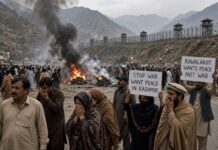
In a dramatic escalation of long-simmering grievances, thousands of residents in Pakistan-administered Kashmir, also known as Azad Kashmir or Pakistan Occupied Kashmir, took to the streets today in what organizers described as an “indefinite shutter-down and wheel-jam” strike. The protests, spearheaded by the Joint Awami Action Committee (JAAC), demand urgent relief from skyrocketing inflation, reduced electricity tariffs, and the withdrawal of recent wheat subsidy cuts—part of a broader 38-point charter addressing economic hardships and local autonomy. What began as peaceful demonstrations against the Pakistani government’s policies has now spiraled into violence, with reports confirming that security forces opened fire on crowds, resulting in at least two deaths and over 20 injuries.
Morning Clashes: Security Forces Resort to Live Ammunition
Eyewitness accounts and social media footage from Muzaffarabad, the region’s capital, paint a harrowing picture of the day’s events. Protesters gathered near key government buildings to press their demands. However, tensions boiled over when paramilitary units and police, reinforced by contingents from Punjab province, moved to disperse the crowds.
By mid-morning, unverified videos circulating online showed security personnel firing straight into the throng of demonstrators, with civilians scrambling for cover amid bursts of gunfire. One clip captured a young protester collapsing after being struck, while others displayed spent bullet casings as evidence of the forces’ use of live rounds. Local reports indicate that at least two individuals succumbed to gunshot wounds, with 22 others hospitalized, some in critical condition.
“The forces are shooting directly at us—it’s a massacre,” one anonymous protester told reporters via smuggled messages, echoing sentiments in viral posts from the region. Another video showed injured youth being rushed to a local hospital on makeshift stretchers, their clothes bloodied from what appeared to be bullet impacts.
Internet Blackout and Media Clampdown
Complicating the flow of information, Pakistani authorities imposed a near-total internet shutdown across Azad Kashmir early Monday, severing mobile data and landline services in a bid to curb the spread of protest footage. Journalists attempting to cover the unrest faced arrests and abductions, with multiple reporters detained in broad daylight, according to activist accounts. An unofficial curfew has been enforced in hotspots like Muzaffarabad and Mirpur, where clashes reportedly intensified, including allegations of protesters capturing and disarming soldiers.
The All Parties National Alliance (APNA), a coalition of local political groups, condemned the crackdown as “state terrorism,” urging international observers to intervene. “This is not about flour prices anymore; it’s about our right to live free from oppression,” said a JAAC spokesperson in a pre-shutdown statement.
Broader Context: A Region on the Brink
The unrest traces back to July 2025, when a 60% hike in wheat flour prices—amid Pakistan’s worst economic crisis in decades—ignited public fury. Protests have since snowballed, drawing parallels to the 2023 uprisings in Gilgit-Baltistan over similar grievances. Demonstrators accuse Islamabad of exploiting the resource-poor territory while neglecting basic needs like subsidized power and land rights.
Security has been ramped up since the weekend, with entry points to major towns sealed and additional troops deployed. Reports also surfaced of the Inter-Services Intelligence (ISI)-backed Muslim Conference joining forces with police to quell the crowds, further fueling accusations of a coordinated suppression.
As night falls, the strike shows no signs of abating. Protesters vow to continue until their demands are met, while the Pakistani government has yet to issue an official statement on the fatalities. Human rights groups have called for an independent probe into the use of force.
This developing story underscores the fragility of stability in the disputed Himalayan region, where economic despair intersects with deep-seated political tensions. Updates will follow as information emerges despite the communication blackout.