ISLAMABAD — Pakistan is carving out a role as a strategic conduit between China and Saudi Arabia, leveraging military pacts, shared infrastructure and Chinese-supplied weaponry. Yet this pivot risks alienating Washington at a moment when Islamabad has worked to warm relations with the United States, potentially igniting a diplomatic crisis.
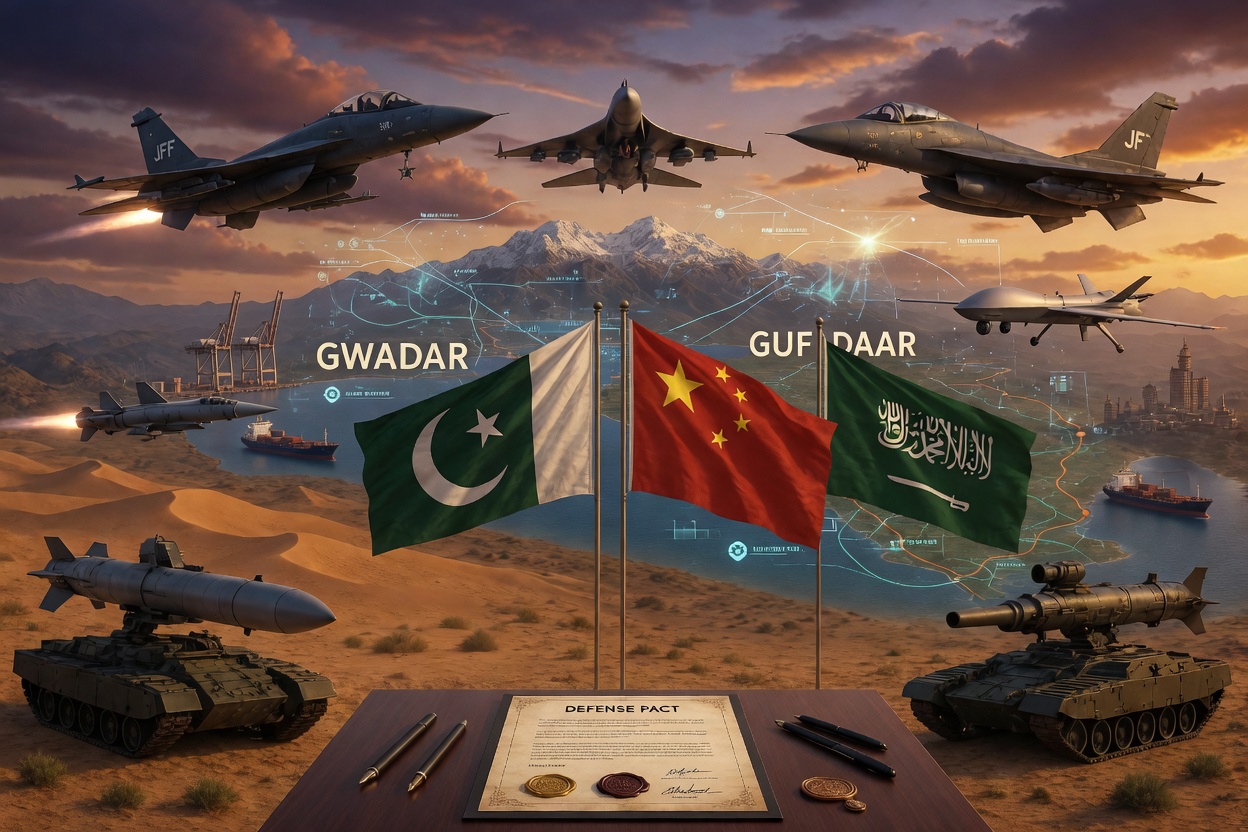
An exclusive report by South China Morning Post highlighted how Pakistan’s new mutual defense agreement with Saudi Arabia, signed in September 2025, and the deployment of Pakistani forces equipped with predominantly Chinese arms could position Islamabad as “the operational face of Chinese defence systems” in the Gulf. With roughly 80 percent of its imports from China in recent years, Pakistan offers Beijing a low-risk venue to showcase systems like the LY-80 air defense and JF-17 fighters in operational settings near critical energy routes.
Analysts say this setup grants Chinese weapons “exposure without risks,” building credibility in Gulf markets skeptical of Western reliability amid U.S.-Iran tensions and fluctuating American commitments. Saudi Arabia, seeking to diversify beyond traditional suppliers, gains cost-effective options and layered defenses. For Pakistan, it deepens financial ties with Riyadh while advancing the China-Pakistan Economic Corridor (CPEC), including Gwadar Port as a potential hub linking Belt and Road initiatives with Saudi Vision 2030.
U.S. Concerns Over Arms Proliferation
If this conduit accelerates direct or indirect Chinese arms sales to Saudi Arabia — through joint production, technology transfer or Pakistani-mediated deals — Washington could view it as a betrayal. The United States has long dominated Saudi defense procurement, supplying advanced systems under strict end-use agreements. Deeper integration of Chinese platforms risks technology leakage, interoperability issues with U.S. equipment and erosion of America’s strategic leverage.
U.S. officials have historically expressed concerns about Saudi diversification toward China or Pakistan, particularly regarding sensitive technologies. A surge in Chinese-origin systems in the kingdom, facilitated by Pakistan, could prompt reviews of arms sales, intelligence sharing or broader security cooperation with Riyadh. For Islamabad, already navigating U.S. scrutiny over its China ties, this could trigger sanctions threats, reduced economic incentives or diminished counterterrorism collaboration.
Pakistan’s Delicate U.S. Thaw
The timing amplifies the risk. After years of strained relations, Pakistan has cozied up to Washington in 2025-2026. High-level engagements under the Trump administration — including meetings with Army Chief Asim Munir — have yielded trade deals, critical minerals cooperation and Pakistan’s role in U.S.-Iran de-escalation efforts. Islamabad has positioned itself as a pragmatic partner, offering mediation and access to resources while seeking investment alternatives to heavy Chinese debt.
This warming trend reflects mutual pragmatism: Washington values Pakistan’s influence in Afghanistan, Iran and countering certain regional threats, while Islamabad seeks diversification. Yet advancing a China-Saudi axis through military channels could undermine that progress, forcing Pakistan into a classic bind — balancing Beijing’s economic heft, Riyadh’s financial support and Washington’s security expectations.
Observers warn of a potential crisis. U.S. lawmakers and defense hawks may frame Pakistani-enabled Chinese arms flows as destabilizing, especially if linked to Saudi nuclear hedging rumors. Islamabad’s leadership, keen to avoid over-reliance on any single patron, risks accusations of duplicity. Security threats to CPEC projects and domestic economic pressures further complicate choices.
Geographic and Diplomatic Linchpin
Gwadar remains central. Proposals for a Pakistan-Saudi Economic Corridor could integrate Saudi capital with Chinese infrastructure, creating energy and trade arteries. Diplomatically, Pakistan has bridged de-escalation talks involving China, Saudi Arabia and broader Gulf actors.
Yet success hinges on managing great-power sensitivities. For China, Pakistan provides deniability and market access; for Saudi Arabia, options beyond U.S. strings; for Pakistan, relevance and resources. The peril lies in overreach: a conduit that becomes a flashpoint.
In a multipolar landscape, Pakistan’s geography offers leverage but demands deft navigation. As one analyst noted, threading the needle between Beijing’s systems, Riyadh’s ambitions and Washington’s expectations will test whether Islamabad’s bridge-building fortifies or fractures its position. Failure could leave it diplomatically isolated, economically exposed and strategically squeezed.